
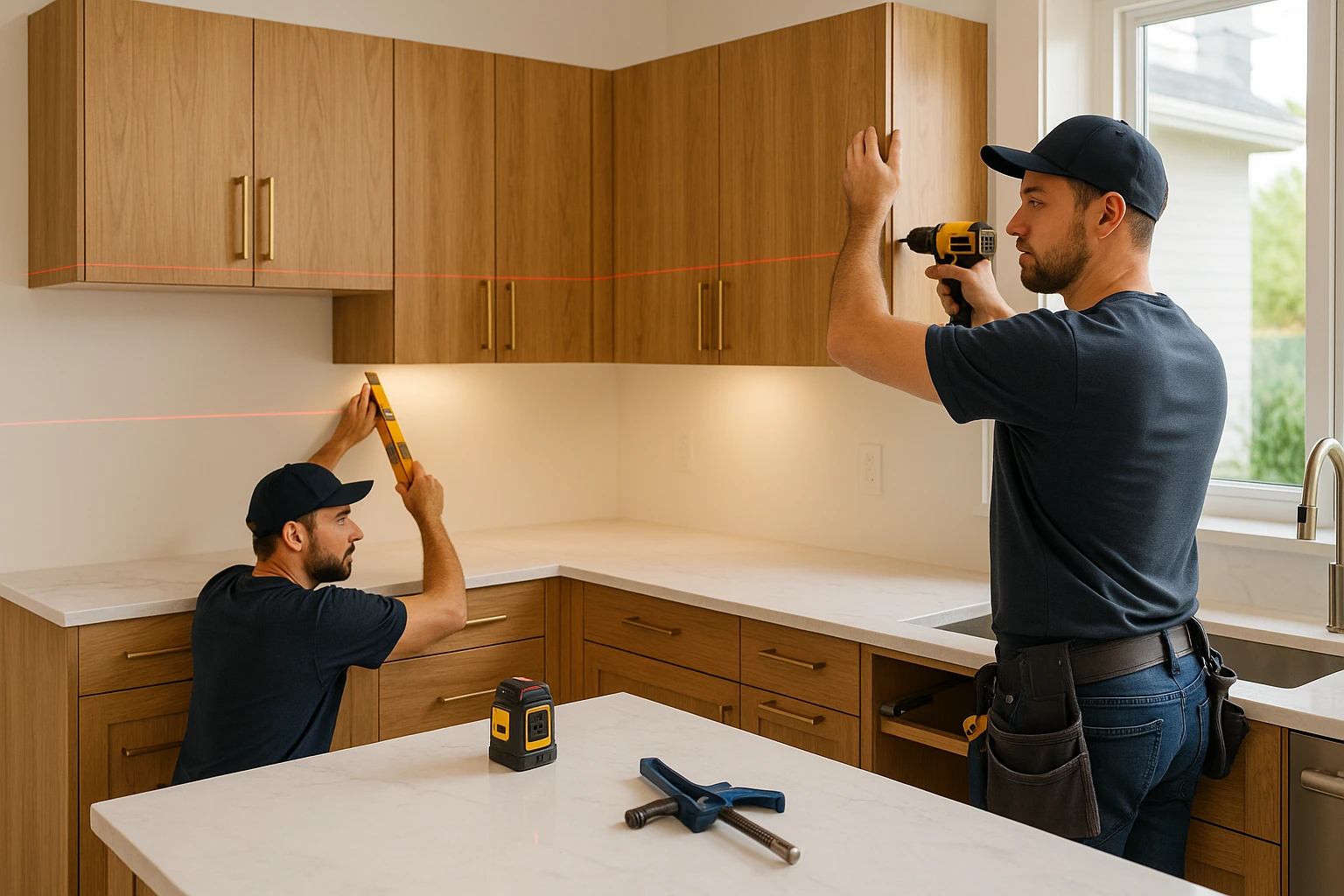
Custom Kitchen Cabinet Installation is one of the most valuable upgrades you can make to a home—boosting design, function, efficiency, and long-term property value. Whether you’re a homeowner, designer, or contractor, understanding this multi-stage process helps ensure flawless results and maximum lifespan for your cabinetry.
This guide explains exactly how custom cabinet installation works, who is involved, how long each step takes, the technical details behind leveling and mounting, and what to expect before, during, and after installation.
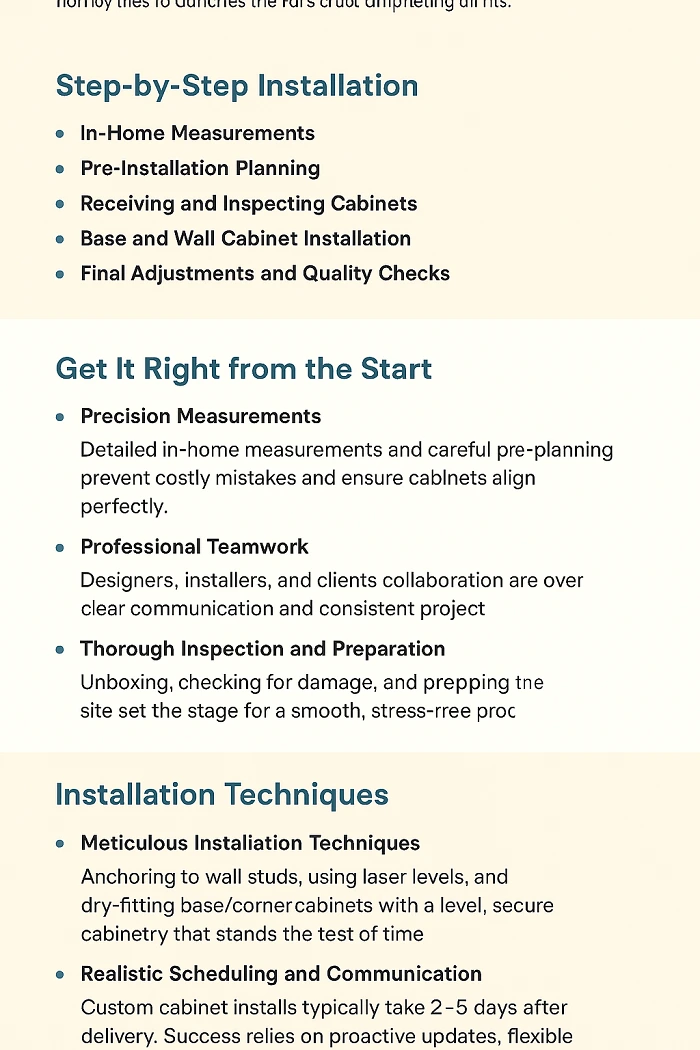
- Precision from day one ensures a truly custom fit—detailed in-home measurements and careful pre-planning prevent costly mistakes and guarantee every cabinet aligns perfectly.
- Professional teamwork drives quality, with designers, installers, and clients collaborating at every step for clear communication and consistent project progress.
- Thorough inspection and preparation before installation—unboxing, checking for damage, and prepping the site—set the stage for a smooth, stress-free process and protect your investment.
- Meticulous installation techniques—like anchoring to wall studs, using laser levels, and dry-fitting base/corner cabinets—deliver level, secure cabinetry that stands the test of time.
- Realistic scheduling and communication matter; custom cabinet installs typically take 2–5 days after delivery, but success relies on proactive updates, flexible planning, and addressing delays as a team.
- Coordinating with other trades—such as plumbers, electricians, and countertop installers—avoids delays, protects finishes, and ensures seamless fit and function for your new kitchen.
- Final adjustments and comprehensive quality checks guarantee that every door, drawer, and hardware operates flawlessly, with a detailed walkthrough and care guidance before project completion.
- A properly installed custom kitchen can increase home value by up to 70-80% of project cost, while expert care and regular maintenance keep cabinets looking and working like new for years.
By following these proven steps, you’ll enjoy a kitchen that’s both stunning and practical—crafted and installed with the uncompromising standards IL Cabinets is known for. Ready to see every detail of this process in action? Dive into the full article for an in-depth walkthrough.
Introduction
Imagine unboxing your new custom kitchen cabinets—only to discover that just a fraction of a millimeter off in installation can mean crooked doors, misaligned drawers, or costly adjustments weeks later.
It’s a detail many underestimate, yet precision in cabinet installation is what separates a flawless, tailor-made kitchen from a frustrating redo.
If you’re a homeowner, designer, contractor, or business owner investing in custom cabinetry, you already know that the difference lies in the details.
But what actually goes into that transformation—from raw plans and careful measurements to that first silky-smooth drawer glide?
A world-class kitchen isn’t just about the beauty of wood grain or the richness of a finish; it’s about how each piece fits together.
Expert installation turns your vision into reality, ensuring:
- Picture-perfect alignment—so every cabinet sits proud and true
- Smooth operation—quiet hinges, seamless drawers, effortless access
- Longevity and peace of mind—protecting both your investment and your warranty
With today’s busy schedules and rising renovation standards, understanding how the installation process unfolds lets you plan, coordinate with other trades, and avoid the common pitfalls that disrupt even the best-designed kitchens.
We’ll break down:
- Who’s involved and what to expect at every stage
- How accuracy and craftsmanship affect both form and function
- The keys to preparation, collaboration, and long-lasting results
From first measurements to final adjustments, you’ll discover why attention to detail transforms more than just a kitchen—it elevates your entire space.
Ready to see how a truly custom installation begins? Your journey starts here, with a clear-eyed view of the process that brings your cabinetry—and your home’s potential—to life.
Understanding Custom Kitchen Cabinet Installation: Process Overview
Custom kitchen cabinet installation is a multi-stage journey designed to deliver both striking beauty and seamless functionality.
From the first measurements to the final adjustments, every detail affects the final result.
Who’s Involved: Roles in the Installation Journey
Picture this:
- Designer creates a tailored plan reflecting your kitchen’s unique dimensions and style preferences.
- Installer translates that vision with precise, skillful mounting—ensuring every cabinet is level and secure.
- Client collaborates on details, approves plans, and stays informed throughout key project milestones.
Clear teamwork between these roles is the secret to installation excellence.
Step-by-Step Installation Path
The process flows in carefully coordinated steps:
- Initial In-Home Measurements – Precision here locks in that custom, built-for-you fit.
- Pre-Installation Planning – Designers check design elevations, installers review all tools and hardware, and clients prep the space.
- Receiving and Inspecting Cabinets – Every box is unboxed and reviewed for accuracy, quality, and completeness—catching any hiccups before work begins.
- Base and Wall Cabinet Installation – Installers use tools like laser levels and stud finders for flawless placement, securing each cabinet to perfectly align with adjacent units.
- Final Adjustments and Quality Checks – Doors, drawers, and hardware installed with care for smooth, silent operation.
The Value of Precision: Aesthetics, Functionality & Warranty
Why does each step matter?
- Precise installation ensures doors swing smoothly, drawers glide quietly, and every edge lines up—details that keep your kitchen looking custom year after year.
- Accurate mounting protects your cabinetry investment by upholding manufacturer warranties and preventing avoidable wear.
Project Duration, Disruptions, and Realistic Expectations
Custom cabinetry installation typically spans 2–5 days once all materials arrive.
- Timeline depends on kitchen size, complexity, and site readiness.
- You can expect some dust and intermittent noise—plan ahead for minimal kitchen access during work hours.
- Seasoned professionals communicate updates, adapting quickly if timelines shift due to site or material surprises.
Throughout this process, attention to detail makes all the difference; the result is a kitchen that feels like it was made just for you.
Expect a transformation: what starts as careful measurements and checklists ends with cabinetry that’s as solid as it is stunning. That’s the IL Cabinets promise—“Crafting Your Vision Into Reality.”
Preparation and Pre-Installation Planning
In-Home Measurements and Site Assessment
Accurate measurements are the foundation of flawless cabinet installation. Picture your future kitchen: crisp lines, no gaps, every cabinet a perfect fit.
A professional installer will:
- Use a laser level and tape measure to precisely capture wall lengths, ceiling heights, and floor angles
- Review finalized floor plans and design elevations onsite before cabinets arrive
- Double-check that every measurement matches the custom cabinetry order to catch problems before they start
A simple pre-install checklist could include:
- Matching wall dimensions to order forms
- Confirming window, appliance, and plumbing locations
- Ensuring obstructions are accounted for
“Measure twice, install once—precision here means a kitchen that feels built just for you.”
Inspecting and Unboxing Cabinets
Cabinet delivery day is when quality becomes tangible. Before tools come out, inspect each piece.
- Unbox every cabinet and lay them label-side up for easy identification
- Check for shipping damage, missing parts, or flaws in the finish
- Inventory all hardware, shelves, and accessories so nothing is missing
If you spot a problem:
- Photograph damage or discrepancies immediately
- Contact your installer or supplier for a fast resolution—most reputable brands will quickly support any concern
“Unwrapping your custom cabinets should feel exciting, not stressful—be thorough and proactive to keep things on track.”
Room Readiness and Tool Preparation
A smooth install starts with a prepared, protected space.
- Clear the work area of furniture, décor, and flooring obstructions
- Clean all surfaces and add protective coverings to floors and counters
- Ensure access to electrical outlets, water shut-offs, and proper lighting
Professional installers set up with:
- Tape measures, laser/standard levels, power drills, stud finders, clamps, and safety equipment
- All fasteners and hardware checked off prior to starting
Coordinating with other contractors or homeowners about utilities means fewer delays and surprises.
“A well-prepped space is the secret to a fast, flawless installation—it’s what separates pros from DIYers.”
Timeline and Lead Times: What to Expect
Typical lead times for custom cabinetry range from 6 to 12 weeks post-order, based on design complexity and manufacturer workload.
Plan for:
- Delays due to material availability, design changes, or construction setbacks
- Installation itself generally takes 2–5 days, but may need to align with flooring, electrical, or plumbing work
- Transparent communication from your installer about any changes
“Timelines aren’t just numbers; they’re the difference between a seamless kitchen renovation and weeks of frustration.”
Careful prep is your first ingredient for a successful installation. When you take these steps seriously, your custom cabinetry will fit, function, and look exactly as you imagined—right from day one.
The Base Cabinets Installation Process
Locating the Starting Point and Planning Layouts
Base cabinet installation starts with absolute precision. Finding the highest point of your kitchen floor matters—it ensures your cabinets end up completely level, even in older homes with subtle dips or slopes.
- Use a laser level, chalk line, and a sturdy ledger board to mark the correct cabinet height along every wall.
- Transfer your design from paper to reality by marking where each cabinet unit will sit.
- “Picture this: precise marks and lines that guide every step—no guesswork, just craftsmanship.”
This careful layout prevents uneven countertops and gaps later—a detail that separates professional results from “good enough.”
Dry-Fitting, Marking Studs, and Pre-Installation
Before you secure a single screw, dry-fit the cabinets to check clearances, making sure appliances, plumbing, and doors won’t collide.
- Use a stud finder to locate and mark wall studs; always anchor cabinets to these for long-term strength.
- Remove drawers, fronts, and hardware, labeling each for easy reassembly.
- Safeguard all removable components—set them aside on padded surfaces.
Creating these habits from the start means zero surprises and smooth progress down the road.
Securing Cabinets: Step-by-Step
#### Mounting the Corner Cabinet
The corner cabinet goes in first—it sets the angle and height for every box to follow.
- Level the cabinet on the ledger board, inserting shims if needed to account for wall irregularities.
- Anchor the cabinet with 3-inch #10 screws directly into studs (or use toggle bolts for drywall).
- “Nothing impresses like a flawless corner—the foundation of a designer kitchen.”
Common challenges like bowed walls or out-of-square corners can be solved on the spot with smart shimming and patient adjustments.
#### Attaching Sequential Cabinets
With the corner in place:
- Clamp the next cabinet to it for a seamless, unified look.
- Drill pilot holes and fasten through the frame using 2½-inch #8 screws for a secure connection.
- Always work outward, checking level and plumb after each cabinet.
Pro tip: Tighten fasteners gently and evenly—over-tightening can mar your cabinet’s finish.
Fine-Tuning and Adding Finishing Elements
Once all units are mounted, it’s time for final touches:
- Install fillers, end panels, and toe kicks for a built-in, polished result.
- Double-check every unit is still perfectly level, prepping for countertop installation.
- Wipe away dust and debris—your clean, custom fit is ready to shine.
A well-installed base is the backbone of a stunning kitchen, where “every cabinet sits proud and true.”
The takeaway: Meticulous layout and installation mean you enjoy beauty and performance for decades—because every great kitchen starts from the ground up.
The Wall Cabinets Installation Process
Planning, Elevation Markings, and Safety
Precise installation starts with marking wall elevations for every cabinet run. This ensures all upper cabinets line up perfectly—a must for a polished kitchen.
Using a laser level or chalk lines, installers draw height guidelines, creating a consistent, level foundation from the very first cabinet.
When working above shoulder height, safety comes first:
- Use sturdy step stools or scaffolding for stability
- Wear protective eyewear to shield from dust or debris
- Clear the area beneath for easy movement and reduced trip hazards
Always start from the corner cabinet, then work outward. This workflow helps maintain accuracy and keeps the project on track.
“Begin with the corner—every line afterward falls into place.”
Anchoring Corner and Subsequent Wall Cabinets
Before lifting a cabinet, remove all doors and hardware to avoid scratches and reduce weight.
For each wall cabinet:
- Transfer wall stud markings onto the back of the cabinet using pencil lines
- Check for wall irregularities; use shims for perfect alignment
- Drill pilot holes at key points for clean, controlled fastener entry
Securing starts with the corner unit. Attach it directly to studs with 3-inch screws for rock-solid support.
“Studs are your anchor—the farther apart, the less secure your cabinetry.”
Connecting Cabinets and Securing to Studs
Connect adjacent cabinets using C-clamps for tight, seamless joins:
- Drill 3/32-inch pilot holes through face frames at three points (top, middle, bottom)
- Insert 2½-inch screws to pull cabinets tight together, then countersink for a smooth look
Check level and plumb after each new cabinet install.
Reinforce every cabinet into at least two studs for long-term durability—a key step that protects your investment for years to come.
“Level at every step. One crooked cabinet can throw off the entire wall.”
Finishing Details for Wall Cabinets
With all cabinets up, it’s time to add finish pieces that elevate the room:
- Install moldings and crown for a built-in, custom look
- Fit decorative overlays, end panels, and filler strips for seamless joins
- Add column posts or corbels as designed, ensuring flush, flush finishes
Final touches—like adding soft-close hinges or glass inserts—bring personality and style to your wall cabinetry.
Precision in wall cabinet installation means more than just structure—it’s the foundation for a beautiful, enduring kitchen. Every level line, hidden screw, and finishing detail is a testament to craftsmanship, ensuring your custom cabinets look and function their best for years to come.
Final Adjustments and Quality Assurance
Reinstalling Doors, Drawers, and Hardware
Once the main cabinet structure is secure, it’s time for the finishing touches that make your custom kitchen truly shine.
Every door and drawer front is carefully reattached, ensuring each is straight and the gaps—known as “reveals”—are even and symmetrical across the entire installation.
Details like soft-close pulls, knobs, and custom hardware specified by you or your designer are precisely installed.
Adjusting Hinges and Aligning Cabinet Fronts
Before the tools are packed away, installers tackle fine-tuning for perfect operation.
- Hinges are micro-adjusted for smooth, silent movements—no crooked lines or catching doors
- Drawer slides are calibrated for effortless opening and silent closing
- Installers use adjustment screws and alignment techniques to ensure all cabinet faces are flush and consistent
Picture this: each drawer glides out silently with a gentle push, and every door lines up so precisely that it looks like it was laser-cut in place.
Cleaning and Final Walk-Through
After all adjustments, your kitchen space is thoroughly cleaned—no dust, fingerprints, or packaging left behind.
- Cabinets are wiped down inside and out, with attention to both function and finish
- A final walk-through with you ensures every detail exceeds your expectations
- Installers point out special features, demonstrate how to care for new surfaces, and answer questions about initial use or ongoing maintenance
One recent client shared, “Seeing each cabinet polished and aligned perfectly—just as we imagined—was the moment it felt like our kitchen had arrived.”
Expect clear tips for keeping your cabinetry looking flawless and functioning smoothly for years to come.
In these final moments, the emphasis is on craftsmanship, client satisfaction, and setting you up for long-term enjoyment—because what you see and touch every day should feel as exceptional as it looks.
What to Expect: Working with a Professional Installer
Clear Communication and Honest Timeline Updates
When you choose a professional installer for custom kitchen cabinets, expect consistent communication from start to finish.
Installers start with a detailed timeline overview, outlining lead times (typically 2–8 weeks from approved design to installation) and scheduling milestones for delivery, site prep, and cabinet installation.
You’ll receive regular progress updates and direct contact for any questions or changes.
- Transparent project timelines—so you always know what’s next
- Immediate notification of delays, material shortages, or site challenges
- Prompt and respectful change order handling if your needs or the project scope evolve
“Your home renovation deserves full transparency—no surprises, just solutions.”
Focus on Craftsmanship and Customer Experience
Professional installers treat your home with the same care as their own.
Every step, from precise cabinet alignment to protecting floors and walls, is handled with expertise.
Imagine this: Your cabinetry arrives and is unboxed with gloved hands, each piece checked against the order, with high-resolution progress photos shared along the way.
Clients often comment, “Watching the IL Cabinets team work felt like a masterclass in craftsmanship—every detail was triple checked and explained.”
Skilled installation extends the life and integrity of your cabinets by:
- Preventing future sagging, gaps, or misaligned doors
- Protecting finishes and hardware from damage during handling
- Delivering a polished look that stands the test of time
Reliable Warranty, Support, and Ongoing Guidance
The relationship doesn’t end once your kitchen shines.
Your cabinet installation comes with clear warranty terms—often covering workmanship for 1–5 years, depending on provider and project scale.
Get easy access to your installer for:
- Warranty support and post-installation service calls
- Expert guidance on initial care, moisture control, and surface cleaning
- Recommendations for ongoing maintenance to keep your cabinets flawless
“Quality installation is backed by real support—not just promises.”
From first handshake to final walkthrough, a professional installer anchors your project with responsive communication and skilled execution. Knowing what to expect means you can focus on the excitement of your transforming kitchen, confident your investment is in good hands.
Key Considerations for a Seamless Installation Experience
A flawless custom cabinet installation doesn’t happen by chance—it’s the result of careful coordination and proactive planning from day one.
Picture this: The cabinetry arrives just as tile installation wraps, electricians are finishing outlets, and your new appliances glide perfectly into their spots. Every detail flows smoothly because the timeline was mapped out in advance.
Coordinating Other Trades for Smooth Progress
For a streamlined project, it’s crucial to align cabinet installation with other trades working in your kitchen.
- Plumbers: Complete rough-ins for sinks, waterlines, or dishwashers before cabinets go in.
- Electricians: Install wiring for under-cabinet lighting, outlets, or smart appliances prior to cabinet mounting.
- Countertop fabricators: Measure for countertops only after base cabinets are perfectly installed and secured.
Solid relationships and communication between all professionals keep your schedule on track and reduce costly re-dos.
Preparing for Flooring, Lighting, and Appliances
Arrange installation tasks in the right order to protect your investment and avoid project hiccups.
- Install most types of flooring before cabinetry to ensure a seamless look and prevent future issues with plinths or toe kicks.
- Ensure lighting fixtures are in place so you can check cabinet colors and finishes in actual site conditions before sign-off.
- Schedule appliance delivery for after cabinetry is complete, but have specs ready for precise cabinet fit—this avoids last-minute adjustments!
A misstep here can cause frustrating delays and drive up costs.
Avoiding Common Pitfalls: Scheduling, Access, and Communication
The number one challenge in home renovations? Clarity and communication. Set yourself (and your team) up for success by addressing these head-on:
- Lock in flexible but realistic scheduling—custom cabinetry can take 8-12 weeks from order to install, with minor delays possible.
- Ensure clear site access: Reserve parking, clear pathways, and set up a staging area for unboxed cabinets.
- Use group texts or shared documents for timeline updates and approvals—a quick message beats a long phone game any day.
“Asking questions early saves headaches later—expect your installer to value your engagement.”
Staying Engaged and Informed
Remain hands-on—your vision matters.
- Review the design and site plan with your installer before day one.
- If something looks off or you have a concern, ask for clarification on the spot—proactivity helps protect both the aesthetics and the warranty of your cabinetry.
- Many satisfied IL Cabinets clients say real-time communication was the difference between a stressful project and a smooth one.
By prioritizing planning, open communication, and order-of-operations, you can expect a seamless, low-stress cabinet installation that maximizes both form and function.
Keeping everyone in the loop—your installer, other trades, and you—will transform your kitchen project from worry to wow.

Connecting to the Bigger Picture: Cabinetry Value, Longevity, and Care
A flawless installation is not just about looks—it’s the single greatest factor influencing your kitchen’s long-term value and performance.
Poorly installed cabinets can develop sagging shelves, uneven door alignment, and even structural issues that void manufacturer warranties.
Proper installation ensures your investment looks stunning and outlasts trends, with seamless reveals and perfectly aligned hardware that speak to true craftsmanship.
How Installation Impacts Cabinetry Value
The way your cabinets are set determines:
- Aesthetics: Uniform gaps, smooth door operation, and integrated finish details
- Durability: Cabinets stay plumb, level, and tightly secured—reducing movement, damage, or wear
- Resale Appeal: Kitchens with expertly set custom cabinetry can increase home value by up to 70-80% of the project cost, according to national remodel data
“Expert installation turns custom cabinetry from a purchase into a generational asset.”
Achieving Longevity: What Makes Cabinets Last?
Small details make a big difference in lifespan:
- Secure mounting at multiple stud points to handle years of daily use
- Precision with shims and fillers to manage minor wall or floor imperfections
- Proper adjustment of hinges and slides for silent, smooth operation
Think about it: a single misaligned mounting point can cause a cascade of creaking doors, sticky drawers, and cabinet warping in as little as 12 months.
Essential Cabinet Care: Immediate Actions You Can Take
Protect your investment starting day one with:
- Regularly wiping down surfaces to prevent grime and moisture build-up
- Checking hinge screws and hardware tightness each year
- Using gentle, non-abrasive cleaners for all finish types
For deeper tips, see our comprehensive guides:
- [How Custom Cabinets Add Value to Your Home]
- [Best Practices for Kitchen Cabinet Maintenance]
- [Choosing Durable Cabinet Materials for Midwest Homes]
Skilled installation is the invisible guarantee behind every beautiful kitchen, making your space more functional, resilient, and valuable for decades.
No matter your cabinet style, remember: “Craftsmanship you can see starts with expertise you can trust.” With the right care and a quality install, your kitchen becomes a daily source of pride and lasting value.
Conclusion
Bringing your custom kitchen vision to life is about much more than installation—it’s about creating a space that truly reflects your taste, enhances everyday living, and stands the test of time.
With expert craftsmanship and a focus on seamless process, you unlock not only elegant design but also reliability, peace of mind, and lasting value.
—
Here’s what to keep top of mind as you move forward:
- Start with professional, precise measurements to guarantee the perfect fit and smooth installation.
- Collaborate openly with your designer and installer, sharing questions or preferences early—clear communication leads to extraordinary results.
- Coordinate closely with other trades (like electricians or plumbers) to streamline your project and prevent delays.
- Inspect your cabinets and site thoroughly before installation day—details caught early save time and trouble later.
- Invest in ongoing care by following simple maintenance routines—protect your cabinetry investment for years to come.
—
Ready to take action?
- Schedule an in-home consultation with a trusted professional to jumpstart your cabinetry project.
- Create a simple checklist with your installer so every step, from delivery to finishing touches, is covered.
- Share your vision and goals openly—the more your team understands your style, the more tailored your kitchen will be.
—
A well-orchestrated cabinet installation isn’t just about how your kitchen looks today—it’s about building a space that will inspire, serve, and delight every day for years ahead.
—
As you take your next steps, remember:
“Crafting your dream kitchen starts with collaboration, craftsmanship, and care—your new favorite space is closer than you think.”
Kitchen Remodeling Inspiration on Houzz
FAQs
1. What is the process of custom kitchen cabinet installation?
Custom kitchen cabinet installation includes precise in-home measurements, site preparation, unboxing and inspection, mounting base and wall cabinets, aligning doors and drawers, and final quality checks. Each step ensures a perfect fit, smooth operation, and long-term durability.
2. How long does custom cabinet installation take?
Most custom cabinet installations take 2–5 days once all materials have arrived. Larger or more complex kitchens may take longer, especially when working around plumbers, electricians, or countertop installers.
3. Why are accurate measurements so important?
Precision measurements prevent misaligned doors, uneven countertops, appliance fit issues, and avoidable delays. Even a few millimeters off can cause major installation problems later.
4. Who is involved in a kitchen cabinet installation project?
A successful project typically involves a designer, a professional installer, and the homeowner. Additional trades such as electricians, plumbers, and countertop fabricators may coordinate with the installation schedule.
5. What should I do to prepare my home before cabinet installation?
Clear the workspace, protect flooring, confirm electrical and plumbing locations, provide access for installers, and ensure good lighting. Prepping the area reduces delays and helps installers work efficiently.
6. What happens during cabinet delivery and inspection?
Installers unbox every cabinet, check for shipping damage, verify all parts and hardware, and confirm items match the approved design. Any issues are documented immediately to avoid project delays.
How can I schedule a professional custom kitchen cabinet installation?
You can easily schedule your installation by visiting our Custom Kitchen Cabinet Installation Service Page. There you’ll find details on consultation options, project timelines, and how our expert installers ensure a flawless, long-lasting result for your home.