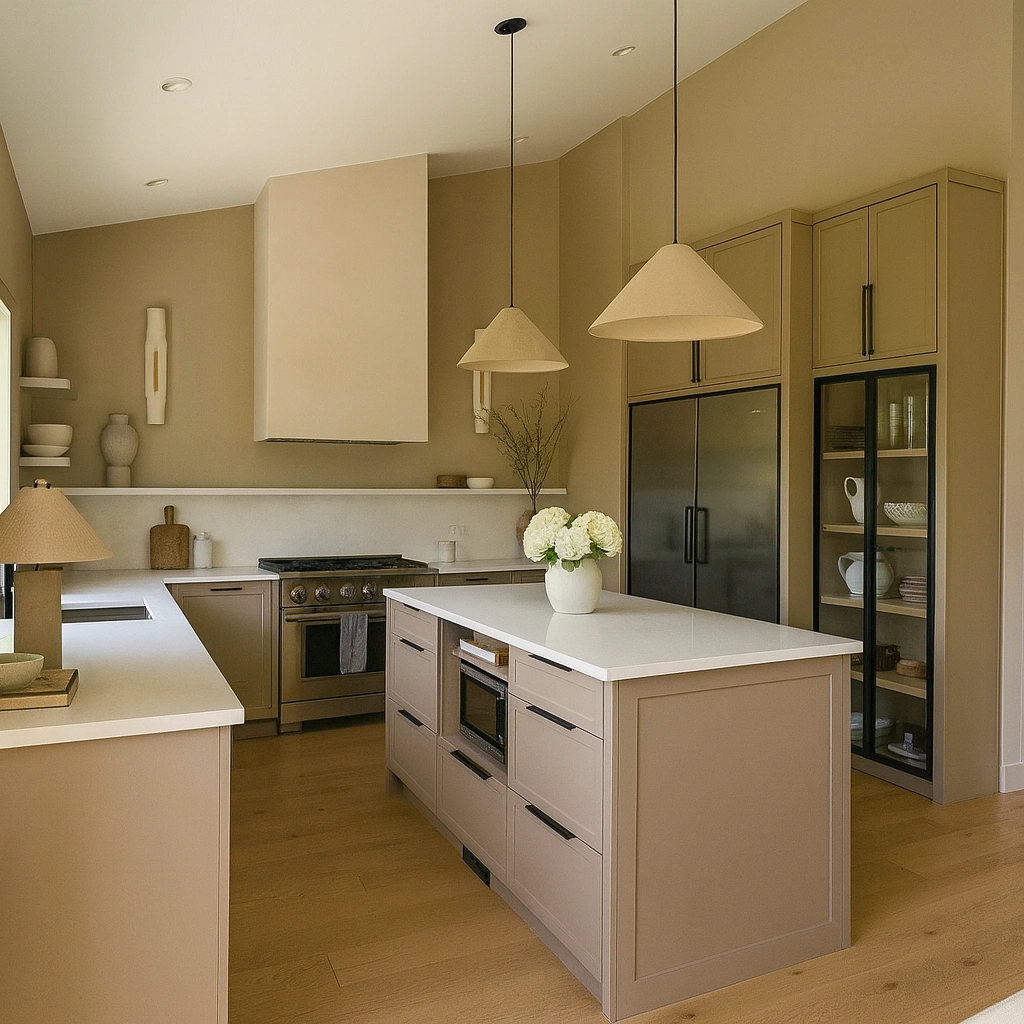
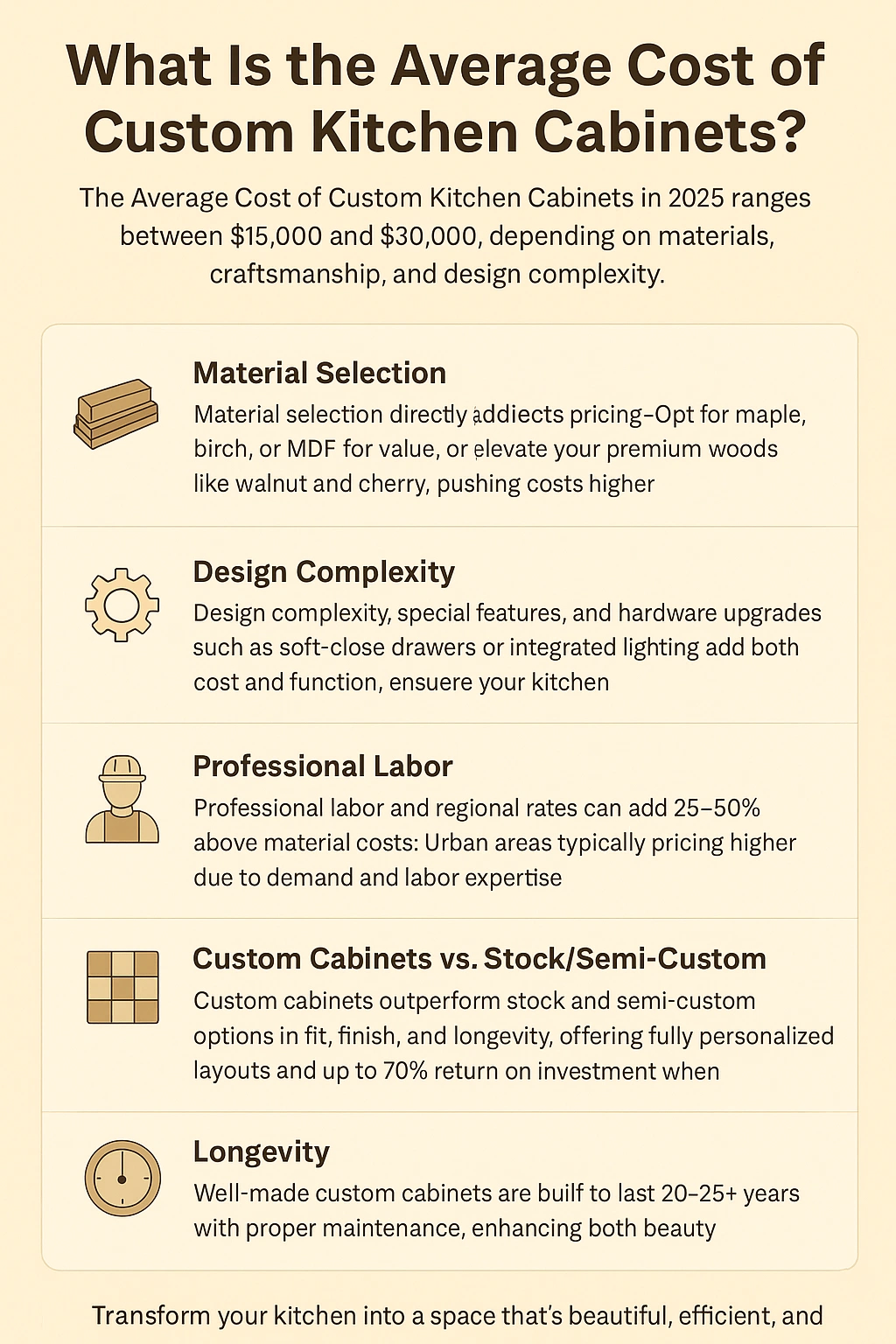
The Average Cost of Custom Kitchen Cabinets in 2025 ranges between $15,000 and $30,000, depending on materials, craftsmanship, and design complexity.
- Material selection directly drives pricing—opt for maple, birch, or MDF for value, or elevate your space with premium woods like walnut and cherry, pushing costs higher but increasing durability and visual appeal.
- Design complexity, special features, and hardware upgrades—like soft-close drawers or integrated lighting—add both cost and function, ensuring your kitchen reflects your unique lifestyle.
- Professional labor and regional rates can add 25–50% above material costs, with urban areas typically pricing higher due to demand and labor expertise.
- Custom cabinets outperform stock and semi-custom options on fit, finish, and longevity, offering fully personalized layouts and up to 70% return on investment when selling your home.
- Plan your project budget carefully by including a 10–20% contingency for unexpected expenses and requesting itemized quotes to spot cost drivers and savings opportunities.
- Longevity and daily satisfaction come standard—well-made custom cabinets are built to last 20–25+ years with proper maintenance, enhancing both beauty and functionality.
- 2025 trends prioritize smart storage, eco-friendly materials, and tactile finishes, making it easier than ever to reflect your style while increasing your home’s value and sustainability.
Transform your kitchen into a space that’s beautiful, efficient, and truly your own—dive deeper into our guide for detailed planning tips and inspiration.
Introduction
Imagine opening your kitchen cabinets and finding that every door glides smoothly, each shelf fits your cookware perfectly, and the finish echoes your personal style—right down to the subtle grain of the wood. That’s the power of truly custom cabinetry: a blend of craftsmanship, creativity, and precision that stock options simply can’t match.
But as you dream about a kitchen designed around you, the big question remains: How much should you budget for cabinets tailored to your space? In 2025, most homeowners can expect to invest $15,000 to $30,000 for a standard custom kitchen—an investment that brings together premium materials, thoughtful layouts, and expert installation.
Why does the price for custom cabinets vary so widely? It’s not just about square footage. Costs shift based on:
- Material choices—from classic maple to statement-making walnut
- Design complexity—including unique organizers, elegant moldings, and standout hardware
- Installation factors—such as labor rates in your city, or custom layouts for unconventional spaces
For homeowners, interior designers, and businesses alike, understanding these variables can mean the difference between a smooth project and sticker shock.
This guide empowers you with clear, honest insight on:
- What makes up a typical custom cabinetry quote
- How pricing compares with semi-custom and stock cabinets
- The real returns in daily function and added home value
- Key trends, smart planning tips, and enduring design choices
If you’re ready to craft a kitchen that reflects your vision—while investing wisely for years to come—you’re in exactly the right place.
Let’s unravel the details behind custom cabinet pricing in 2025, starting with how those costs break down and what drives them higher or lower.
Understanding the Average Cost of Custom Kitchen Cabinets in 2025
Thinking about custom kitchen cabinets? Expect to budget $500–$1,200 per linear foot installed in 2025, with most standard kitchens landing between $15,000 and $30,000 for the full project.
This range reflects the craftsmanship, tailored design, and premium materials that set custom cabinets apart from stock or semi-custom options.
In today’s market, custom cabinetry costs are shaped by:
- Rising labor rates and regional demand (metropolitan areas often run higher)
- Global supply chain fluctuations, which may influence premium hardwoods and specialty finishes
- A growing focus on personalized layouts and smart storage solutions
Picture this: Walking into a kitchen where every cabinet fits your home—and your taste—perfectly. That’s the difference custom makes.
“Custom cabinets are an investment that transforms not just your kitchen, but how you live at home.”
Linear Foot Pricing Explained
A “linear foot” measures the horizontal length of cabinetry—wall to wall—not height or depth.
Most kitchens need 20–30 linear feet of cabinetry, so your cost estimates should be based on that calculation.
Here’s what to expect at different price points per linear foot:
- Value custom: $500–$700 (simpler materials, basic features)
- Mid-range custom: $700–$1,000 (higher-end woods, thoughtful extras like soft-close hardware)
- Luxury custom: $1,000–$1,500+ (exotic woods, intricate design, integrated lighting, custom organizers)
Outlier pricing—up to $2,500 per linear foot—typically reflects ultra-premium features or specialized layouts.
“The more unique your space or design vision, the further you move toward the upper end of custom pricing.”
Total Project Cost Ranges
Every kitchen has its own story—and price tag.
- Small/basic kitchen: $6,000–$14,000
- Standard kitchen: $15,000–$30,000
- High-end/complex project: $30,000–$40,000+
Kitchen size, layout, and storage needs can significantly swing these totals.
For example:
- A compact condo kitchen with minimal corners may be cost-efficient, while a large, open-concept space with a wall of pantry cabinetry or integrated appliances pushes toward the high end.
- Choose pull-out spice racks, designer hardware, or furniture-style islands, and your investment climbs accordingly.
Today’s buyers and designers value quality craftsmanship and tailored storage features—making custom cabinets a wise investment for both daily enjoyment and long-term home value.
When planning, remember: Custom cabinets reflect your personality, your lifestyle, and your investment in home quality. Budget accordingly, and you’ll enjoy both beauty and function for decades to come.
Key Factors Influencing Custom Cabinet Costs
Materials: The Foundation of Cabinet Pricing
The cost of custom kitchen cabinets starts with the materials you choose.
Most clients opt for one of these popular woods or engineered options:
- MDF, Maple, Birch: $300–$400 per linear foot—great for crisp finishes and budget control
- Cherry, White Oak: $400–$700 per linear foot—adds sophistication and rich texture
- Walnut and Premium Woods: Up to $1,200 per linear foot or more for dramatic grain and luxury feel
Specialty materials—think exotic woods, glass fronts, or metal accents—can boost both style and price.
Eco-conscious shoppers are seeking out sustainable and FSC-certified woods, low-VOC finishes, and recycled content cabinetry. These features bring peace of mind as well as lasting beauty.
“Material choices are the single most important driver of your cabinet’s look, feel, and price.”
Design Complexity and Cabinet Features
The complexity of your design and desired features has a direct cost impact.
Door style sets the tone, whether you choose:
- Shaker, slab, raised panel, or custom profiles (each with differing material and labor needs)
- Painted, stained, high-gloss, or textured finishes add unique visual flair and affect pricing
Looking for those finishing touches? These elements add cost and individuality:
- Crown molding, dovetail drawer boxes, specialty hardware
- Built-in organizers, pull-out trays, soft-close hinges, under-cabinet lighting
- Tech integration: Charging stations, smart lights, and appliance “garages”
Customization means your kitchen fits your life—but each layer of detail adds hours (and dollars) to fabrication.
“Picture this: hidden charging drawers, elegant glass panels, and soft-close everything—all tailored to your routines.”
Labor, Installation, and Regional Variations
Labor and installation typically add 25–50% above material costs.
An experienced craftsman is essential for precise fit and flawless finish; their expertise ensures durability and satisfaction.
Consider these influences:
- Major metro areas often see higher rates due to demand and labor costs
- Rural regions may offer savings but fewer specialists available
- Compliance matters: Permits, local codes, and inspection fees can tack on several hundred to several thousand dollars depending on your locale
Labor quality transforms raw materials into heirloom cabinetry, making craftsmanship a non-negotiable investment.
“In a busy Chicago condo or a peaceful suburban kitchen, local labor rates and talent make all the difference in your final cost.”
The price of custom cabinets is shaped by your material selections, design details, and installer’s location. Knowing these levers lets you personalize your project and plan your budget with confidence.
Comparing Custom, Semi-Custom, and Stock Cabinets
Cost Comparison Table
Choosing between custom, semi-custom, and stock cabinets is often the most pivotal budget decision when remodeling your kitchen.
Here’s how average installed costs stack up per linear foot in 2025:
- Stock/Prefab Cabinets: $100–$400
- Semi-Custom Cabinets: $150–$700
- Custom Cabinets: $500–$1,200
Ultra-premium custom options in luxury builds can reach $1,500–$2,500 per linear foot, but most projects stay within the standard range. Each pricing tier reflects more than the cabinet’s shell—it’s about the level of personalization, detail, and material quality.
“For many homeowners, investing in custom cabinetry means never having to compromise on your vision or your storage needs.”
Fit, Finish, and Design Options
Value goes far beyond price tags. Let’s break down key differences at a glance:
- Stock Cabinets:
- Limited colors, sizes, and door styles
- Made for quick ship and basic layouts
- Economical but may require fillers or awkward gaps
- Semi-Custom Cabinets:
- Greater range of finishes, upgrades, and sizing
- Moderate flexibility for unique spaces
- Generally, a step up in hardware and durability
- Custom Cabinets:
- Fully tailored to any design, size, or function
- Premium woods, specialty finishes, and intricate details
- Seamless fit—even in unique or challenging layouts
Picture this: Stock cabinets leaving gaps along angled walls, while custom-built cabinetry hugs every corner—the difference is obvious, even at a glance.
When to Choose Each Option
Custom cabinets add unbeatable value in situations where:
- Your kitchen has unusual dimensions or an open layout
- You want built-in organizers, advanced lighting, or tech integration
- You expect to stay long-term and want cabinets built to last 20–25+ years
Semi-custom or prefab often make sense if:
- You’re working with a strict budget or a short timeline
- The kitchen layout is standard and customization needs are minimal
“Choosing the right cabinet type is as much about how you use your kitchen as how it looks.”
Cost-Benefit Insights
- Custom cabinetry can deliver up to 70% ROI when selling—timeless materials and quality craftsmanship stand out to buyers
- Investing in custom lets you maximize storage, boost daily enjoyment, and create a truly unique kitchen identity
- Prefab options offer budget-friendly speed but may require compromise on fit, features, and future flexibility
The real value of custom cabinetry is the freedom to shape your kitchen around your lifestyle, not the other way around. Even if the upfront cost is higher, the payoff in function, durability, and resale appeal is substantial for those prioritizing a lasting upgrade.
Budgeting and Planning for Your Custom Cabinet Project
Creating an Accurate Budget
When planning custom kitchen cabinets, most homeowners will spend $15,000–$30,000 total, or $500–$1,200 per linear foot installed. Start by measuring your kitchen’s linear feet, then multiply by the cost range that fits your project’s style and quality expectations.
To avoid nasty surprises, smart budgeting means adding 10-20% for contingencies—think unexpected electrical upgrades or permit delays.
Picture this: you’re reviewing your cabinetry quote. Here’s what’s typically included or excluded:
- Inclusions: Cabinets, hardware, basic finish, delivery, and standard installation
- Common Exclusions: Appliance panels, specialty inserts, decorative trim pieces, demolition or old cabinet removal, electrical or plumbing adjustments
For a realistic plan, ask for an itemized proposal that details every line item—seeing these side-by-side can highlight cost drivers or savings opportunities immediately.
—
Additional Considerations That Affect Final Cost
Factor in permits and inspection fees where required—these can range from $100 to $500 depending on your location.
Labor or material delays are more common now; a spike in supply chain issues can add weeks or increase costs by 5–10%. Stay ahead by discussing realistic lead times with your cabinet maker.
Be clear on payment structure:
- Most cabinet makers request a 30–50% deposit up front
- Final payment due on installation or project completion
- Change orders or upgrades may require separate billing
A good rule of thumb: “Budget for all the visible details, but don’t forget the hidden ones.”
—
Working with Your Cabinet Maker
Great results start with clear, ongoing communication. Schedule a design review with your cabinet maker and insist on:
- Approving finish samples in your kitchen’s natural light
- Reviewing accessory hardware for both aesthetics and functionality
- Confirming that all measurements are double-checked on site
Before finalizing your project, be sure to ask:
- Which finishes or features are upgradeable if budget allows later?
- What is the policy on delays or cost overruns?
- Is aftercare—like touch-ups or service calls—included?
By clarifying these expectations, you’ll keep your project on budget and stress-free.
—
Build your budget around real numbers, always cushion for unexpected changes, and keep communication transparent. This approach ensures your custom cabinetry investment is smooth, rewarding, and stays true to your vision.
Added Value: Longevity, Home Value, and Return on Investment
Cabinet Quality and Lifespan
Custom kitchen cabinets aren’t just about beauty—they’re built to last 20–25+ years with daily use.
High-quality craftsmanship means precision joinery, durable finishes, and premium woods or engineered materials that resist wear.
If you picture running your hand along a smooth, solid maple drawer after 10 years, the lasting quality is obvious.
A few essential points for longevity:
- Quality materials (like cherry, white oak, or walnut) maintain structure and color over decades
- Professional finishes protect surfaces from moisture, staining, and scratches
- Periodic maintenance—such as lubricating hinges and quick touch-ups—keeps everything looking and functioning at its best
“Investing in quality cabinetry today means enjoying a flawless kitchen for decades.”
Home Value and Resale Impact
Thinking investment? Custom cabinets typically offer up to 70% ROI when it’s time to sell.
Buyers notice seamless storage, elegant finishes, and clever layouts—features that can add tens of thousands to your home’s value and boost buyer appeal in a crowded market.
For best value retention:
- Choose timeless design elements over trendy fads
- Opt for well-known premium hardware and materials
- Keep the cabinetry in top condition for strong resale impact
“Modern buyers often make kitchen cabinets a deciding factor—transforming your investment into real equity.”
Customization and Personal Satisfaction
Tailored cabinetry brings daily joy and efficiency—picture everything in its place, a perfect fit for your lifestyle.
Real-world transforms include:
- Open shelving for cookbooks and collectibles
- Hidden appliance garages and soft-close drawers for clutter-free living
- Innovative storage—like corner pull-outs or integrated lighting—that makes every inch work for you
Homeowners often share stories of how their kitchens became favorite gathering spots after a custom makeover—feedback that proves value isn’t just measured in dollars.
Custom cabinets deliver on longevity, home value, and daily enjoyment—making them a smart investment for those who care about beauty that lasts and a kitchen that always fits your life.
Trends and Considerations for 2025 and Beyond
Emerging Designs and Features
The custom cabinet world is embracing color-rich surfaces, tactile finishes, and bold hardware in 2025. Matte creams, dramatic deep greens and blues, and rich wood textures are everywhere—picture a kitchen where every cabinet feels tailored.
Smart cabinetry is moving from luxury to must-have. Look for:
- Integrated lighting with automatic sensors
- Hidden charging stations for devices
- Touch-to-open drawers and doors
- Built-in appliance panels for seamless design
Today’s homeowners also want cabinets that are better for the planet. This means:
- Sourcing local hardwoods
- Prioritizing low-VOC finishes and water-based lacquers
- Using recycled content or sustainable materials whenever possible
“If your kitchen reflects both personality and purpose, you’re right on trend for 2025.”
Planning for Changing Needs
As family dynamics and lifestyles evolve, custom cabinetry is adapting. Universal design concepts ensure accessibility for all ages and abilities:
- Soft-close drawers
- Adjustable shelving
- Lowered countertop options
- Pull-out pantries for easy reach
Flexibility is big—with more kitchens featuring:
- Modular storage that can be rearranged
- Convertible islands for entertaining or homework
- Hidden organization for open-concept spaces
“Cabinets aren’t just for storage—they’re crafted for your life’s moments, big and small.”
Why Work with IL Cabinets
IL Cabinets combines artful craftsmanship, innovation, and genuine customer care. Every project begins with listening—your needs, your style, your story.
Clients regularly comment on:
- Tailored solutions that maximize every inch
- Meticulous finishing and joinery
- Responsive project management, from design to installation
- Ongoing support and maintenance even after the last drawer closes
Imagine a cabinet project where you’re part of the process, not just the final result.
“With IL Cabinets, every detail is tailored, and every promise is kept—long after installation day.”
For 2025 and beyond, custom cabinetry means endless creativity, technology that’s truly useful, and spaces as dynamic as your life. Start with a vision—let expert craftsmanship bring it to life.
Conclusion
A beautifully crafted custom kitchen isn’t just about cabinetry—it’s about realizing a space that reflects your personality, simplifies everyday life, and adds lasting value to your home.
With investment comes possibility: custom cabinets empower you to shape your kitchen around your needs and style—and enjoy craftsmanship that stands the test of time.
—
Key Takeaways
- Investing in quality materials and expert craftsmanship pays off for decades—plan your budget with durability and daily enjoyment in mind.
- Request itemized quotes and clear communication from your cabinet maker so you can make smart, confident decisions.
- Prioritize personalized features and functionality—from organization systems to integrated lighting—that support your lifestyle.
- Be proactive about timelines, materials, and aftercare to keep your project smooth and on-budget.
—
Next Steps
- Measure your kitchen and define your priorities—function, aesthetics, or both—for a tailored project scope.
- Consult with expert cabinet makers like IL Cabinets to discuss your vision, explore samples, and understand your options.
- Ask for a detailed, line-by-line estimate—including what’s included and which upgrades are optional.
- Prepare a flexible budget and set realistic timeline expectations—leave room for surprises and fine-tuning.
—
The kitchen you dream about starts with a single step—envision what’s possible, and let craftsmanship bring it to life.
FAQs
1. What is the average cost of custom kitchen cabinets in 2025?
The average cost of custom kitchen cabinets in 2025 ranges between $500–$1,200 per linear foot, depending on material, design, and location.
2. What factors affect the average cost of custom kitchen cabinets?
Material type, craftsmanship, hardware, and regional labor rates all influence the average cost of custom kitchen cabinets.
3. Are custom cabinets worth the investment?
Yes. Custom cabinets offer superior fit, function, and durability—often yielding up to 70% ROI during resale.
4. How do custom cabinets compare to semi-custom and stock options?
Custom cabinets cost more upfront but provide better longevity, design freedom, and premium finishes.
5. Where can I find expert custom cabinet makers?
Explore our craftsmanship at IL Cabinets, or browse our Euro Style Cabinets for design inspiration.
or additional insights on remodeling costs, see HomeAdvisor’s Cabinet Cost Guide.